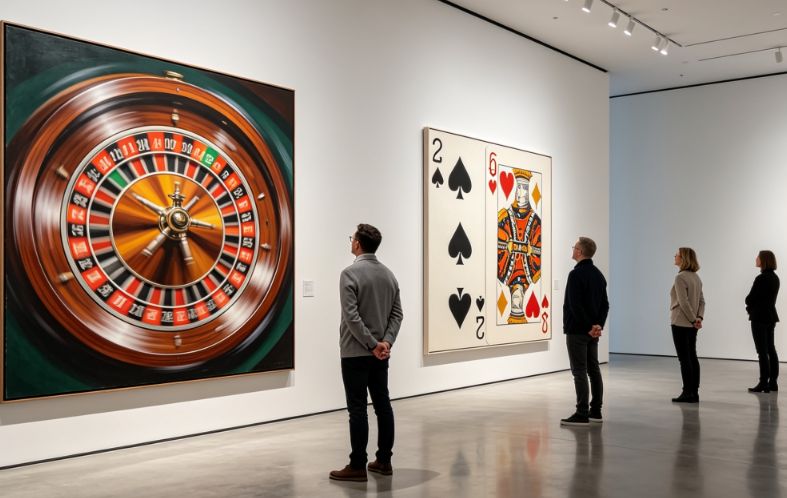
Games of chance have become a recurring visual language in contemporary art. Playing cards, roulette wheels, dice, poker chips, and slot machines are appearing in galleries as artists explore how societies respond to uncertainty, wealth, and ambition. Major international exhibitions in 2026, including the 61st Venice Biennale, continue to demonstrate how contemporary artists use symbolic imagery to examine political, economic, and cultural tensions rather than simple entertainment.
Many curators see gambling themes in contemporary art as a way to question the growing acceptance of financial speculation and high-risk decision-making. Exhibitions presented through the Venice Biennale, including projects such as Baile, Botella y Baraja, show how games, chance, and public rituals can symbolize systems of power, colonial history, and economic control instead of personal fortune. These visual metaphors encourage audiences to think beyond casinos and consider how risk shapes everyday life.
Observation: Risk Becomes a Visual Language
Artists have long borrowed familiar symbols to communicate complex ideas. Today, dice may represent uncertain financial markets, while stacked poker chips can suggest unequal access to wealth. A roulette wheel often becomes a metaphor for unpredictable political decisions or economic cycles.
Reports from the Venice Biennale highlight how many participating artists are focusing on uncertainty, migration, conflict, and social instability. Although gambling imagery is only one of many visual approaches, the broader exhibition reflects an international interest in examining fragile systems and human vulnerability.
Interpretation: Art Challenges the Culture of Speculation
These works invite viewers to ask deeper questions about modern finance and personal responsibility. Stock markets, cryptocurrency investing, online trading platforms, and speculative assets all rely on balancing potential reward against possible loss. Artists often blur the boundaries between calculated investment and pure chance, suggesting that modern economies sometimes encourage behavior that resembles gambling.
Research published by the International Monetary Fund and the World Economic Forum has discussed how technological change, financial innovation, and market volatility influence public attitudes toward risk. Rather than offering economic solutions, artists interpret these realities through emotional and symbolic narratives that statistics alone cannot express.
Museum visitors frequently encounter installations where betting tables become meeting places for conversations about debt, inequality, consumer behavior, and personal aspiration. The familiar objects lower the barrier to engagement while opening space for broader social reflection.
Reflection: Hazard Aesthetics Mirror Collective Anxiety
The popularity of these visual motifs says as much about audiences as it does about artists. Many people now live with economic uncertainty, rising living costs, changing career paths, and rapidly evolving technologies. Gambling imagery reflects those shared experiences by transforming abstract concerns into recognizable symbols.
Studies published by the Organisation for Economic Co-operation and Development continue to show that financial uncertainty affects household confidence and long-term planning across many countries. Art cannot remove these pressures, yet it offers a space where viewers can examine them from a different perspective.
The strongest contemporary artworks avoid celebrating risk. Instead, they encourage careful observation of the systems that reward some participants while leaving others exposed to loss. A painted deck of cards or a carefully arranged roulette table becomes less about winning and more about questioning the rules that shape society.
As galleries continue exploring these themes, gambling-inspired imagery is likely to remain a powerful artistic device. It reminds audiences that every culture develops symbols to explain uncertainty, and today’s artists are using those symbols to spark conversations about economics, ethics, and the human desire to control an unpredictable future.